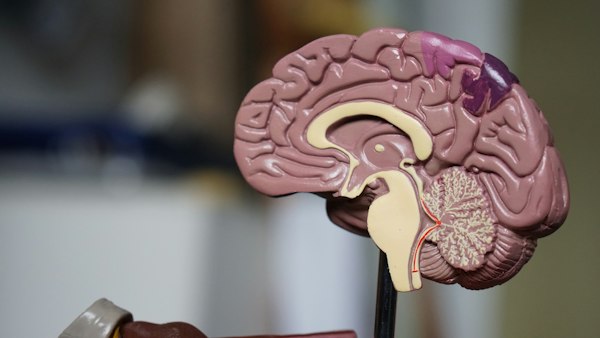
What Is Actually Happening — Central Sensitization
Fibromyalgia is not a disease of the muscles, joints, or connective tissue — despite causing pain in all of these areas. It is a disorder of central pain processing. The central nervous system (brain and spinal cord) amplifies pain signals, processes non-painful stimuli as painful, and fails to adequately dampen incoming pain signals.
This concept is called central sensitization. In a healthy nervous system, the brain has both amplifying and dampening pathways for pain. A stubbed toe sends a pain signal, the brain registers it, and descending inhibitory pathways moderate the response so the pain fades quickly. In fibromyalgia, the amplifying pathways are overactive and the inhibitory pathways are underactive. A study in Arthritis and Rheumatism using functional MRI found that fibromyalgia patients showed 2 to 3 times greater activation of pain-processing brain regions in response to the same pressure stimulus that barely registered in healthy controls.
This means the pain is real — objectively, measurably real in brain imaging — even though there is no damage to the tissues that hurt. A light touch, a firm handshake, or clothing rubbing against skin can be genuinely painful (allodynia). Normal muscle fatigue from everyday activities registers as significant pain (hyperalgesia). Temperature changes, sounds, and bright lights can trigger discomfort.
A 42-year-old accountant described it: "People say it is in my head, and technically they are right — the problem is in my brain's pain processing. But that does not make it imaginary. When I feel like I have been beaten with a baseball bat after doing nothing more than grocery shopping, that pain is real. My brain is just processing normal signals as agonizing ones."
Symptoms — The Constellation That Defines Fibromyalgia
Widespread pain: The defining feature. Pain in multiple body regions — above and below the waist, on both sides of the body. Patients often describe it as aching, burning, or throbbing. It moves around the body. It waxes and wanes but rarely fully resolves.
Fatigue: Not normal tiredness. A bone-deep exhaustion that is not proportional to activity. Sleep that does not refresh. A study in the Journal of Rheumatology found that 76 percent of fibromyalgia patients rated fatigue as one of their most problematic symptoms — often more disabling than the pain itself.
Fibro fog: Cognitive dysfunction affecting memory, concentration, and word retrieval. A study in Arthritis Care and Research found that fibromyalgia patients performed 20 percent worse on cognitive tests compared to age-matched controls. Patients describe losing words, forgetting what they walked into a room for, difficulty following conversations, and inability to multitask.
Sleep disruption: Fibromyalgia disrupts deep restorative sleep. EEG studies show alpha wave intrusion during delta sleep — the brain is partially awake during the deepest sleep stage. This means that even when patients sleep 8 to 10 hours, they never reach the restorative stages. Poor sleep worsens pain sensitivity, creating a vicious cycle.
Associated symptoms: Irritable bowel syndrome (up to 70 percent of patients). Migraines (55 percent). Anxiety and depression (common comorbidities, though fibromyalgia is not caused by depression). Temporomandibular joint disorder (TMJ). Pelvic pain. Sensitivity to light, noise, temperature, and odors.
Diagnosis — No Test, but Clear Criteria
There is no blood test, imaging study, or biopsy that diagnoses fibromyalgia. Diagnosis is clinical — based on symptoms and exclusion of other conditions. The 2016 revised criteria require: widespread pain in at least 4 of 5 body regions, symptoms present for at least 3 months, and a Widespread Pain Index (WPI) and Symptom Severity Scale (SSS) score above defined thresholds.
Before diagnosing fibromyalgia, your doctor should rule out conditions that mimic it: hypothyroidism, vitamin D deficiency, anemia, rheumatoid arthritis, lupus, multiple sclerosis, sleep apnea, and depression. A thorough workup — CBC, thyroid panel, inflammatory markers, vitamin D, metabolic panel — should be done once. Normal results in the context of widespread pain, fatigue, and cognitive symptoms strongly support the diagnosis.
Treatment — What the Evidence Actually Supports
Exercise is the single most effective treatment. This seems cruel — telling someone in chronic pain to exercise. But the evidence is overwhelming. A Cochrane review of 34 trials found that aerobic exercise significantly reduced pain, improved function, and enhanced overall well-being in fibromyalgia. Exercise works by normalizing central pain processing — it activates the descending inhibitory pathways that are underactive in fibromyalgia. Start extremely gently — 5 minutes of walking. Increase by 1 to 2 minutes per week. A study in Arthritis Research and Therapy found that aquatic exercise (warm water pool) was particularly well-tolerated and effective because buoyancy reduces joint loading.
Cognitive behavioral therapy (CBT): A meta-analysis in the Journal of Rheumatology found that CBT reduced pain, fatigue, and disability in fibromyalgia. CBT addresses pain catastrophizing (the tendency to amplify pain's significance), activity avoidance, sleep disruption, and the depression and anxiety that commonly accompany fibromyalgia. It does not dismiss the pain — it changes how you relate to it, which measurably reduces its intensity.
Medications: Three medications are FDA-approved for fibromyalgia. Duloxetine (Cymbalta) — an SNRI that modulates both pain and mood. A study in Pain found it reduced pain by 30 percent or more in roughly 40 percent of patients. Pregabalin (Lyrica) — reduces nerve excitability. Effective for pain, sleep, and anxiety in fibromyalgia. Side effects (weight gain, dizziness) limit tolerability for some. Milnacipran (Savella) — another SNRI. Low-dose amitriptyline (10-25mg at bedtime) is widely used off-label and may be the best tolerated option — it improves sleep, reduces pain, and costs very little.
What does NOT work: Opioids — a study in Arthritis and Rheumatology found that opioids were NOT effective for fibromyalgia and were associated with worse outcomes including increased pain sensitivity (opioid-induced hyperalgesia). NSAIDs alone have minimal effect because the pain is central, not inflammatory. Muscle relaxants have limited evidence.
Sleep optimization: Improving sleep quality reduces pain sensitivity the next day. Sleep hygiene, CBT for insomnia (CBT-I), and low-dose amitriptyline all help. Addressing sleep apnea if present can dramatically improve fibromyalgia symptoms — a study found that 50 percent of fibromyalgia patients had undiagnosed sleep apnea.